In a time where technology drives growth, it can also open the door to cyber threats. With cyberattacks becoming more complex, robust cybersecurity measures are no longer optional but essential, particularly for small businesses that are often more vulnerable. As the backbone of the economy, Australian small businesses must adopt both strategic and straightforward defensive measures to protect themselves from the growing wave of cyber threats. Cybersecurity has evolved from what many see as an IT-compliance checkbox exercise, to a critical strategy that underpins the longevity and livelihood of businesses across Australia.
Cybersecurity threats are rapidly escalating in Australia, with a cybercrime reported every seven minutes and annual costs estimated at over $20 billion. For small businesses with fewer resources, a single cyberattack can threaten their survival; 60% of small businesses fail within six months of a cyberattack, reflecting the critical vulnerability and severe consequences of these breaches. This underscores that cybersecurity is not just a protective measure but an essential investment for the survival and resilience of businesses across the board.
Frameworks like the National Institute of Standards and Technology (NIST) Cybersecurity Framework offer a structured way to manage cybersecurity risks. These frameworks help businesses identify, assess, and respond to cybersecurity risks tailored to their specific situations. For example, the NIST framework consists of five functions—Identify, Protect, Detect, Respond, and Recover—that guide businesses on how to stay resilient against attacks. Following international standards like ISO 27001 also strengthens a business’s defences by enforcing strict security practices that protect data and infrastructure from breaches.
For small businesses, implementing strong cybersecurity measures doesn’t have to be an expensive or onerous practice. Simple, effective steps can greatly enhance security:

Imagine encountering what appears to be a public charging station at an airport for charging your smartphone. You connect your phone, unaware that the USB charging cable has been compromised. Once connected, the malware is transferred to your device, silently installing software that steals personal and corporate data. Hackers then use your data to infiltrate your company’s networks, leading to a major breach which is used in a ransom attempt. Your business becomes severely compromised, all resulting from what seemed like a benign action—simply charging your phone.

Consider a small online retailer whose website has an outdated customer database interface with a security flaw. Cybercriminals use automated scripts to scan thousands of sites for such flaws. When they find the retailer’s vulnerability, they inject malicious code to extract customer data, including credit card details and personal information. This stolen data is then sold on the dark web, leading to identity theft and financial fraud, showing how a single software flaw can lead to significant data loss.
Cybersecurity is about more than just protecting data; it’s about ensuring business continuity and maintaining trust. By understanding and implementing basic cybersecurity practices and frameworks, businesses can significantly reduce their risk and secure their digital operations.
Digital transformation can be complex, high risk and, increasingly, necessary for organisations to stay competitive. In both public and private sectors, digital transformation and business change is the new norm, required to drive improved operational efficiency, enhanced customer and employee satisfaction and boosting revenue growth. Our firm stands at the intersection of business and technology, guiding clients through the complexities of digital transformation. We believe a holistic, integrated view of business, technology and strategy is required to maximize the value of digital transformation.
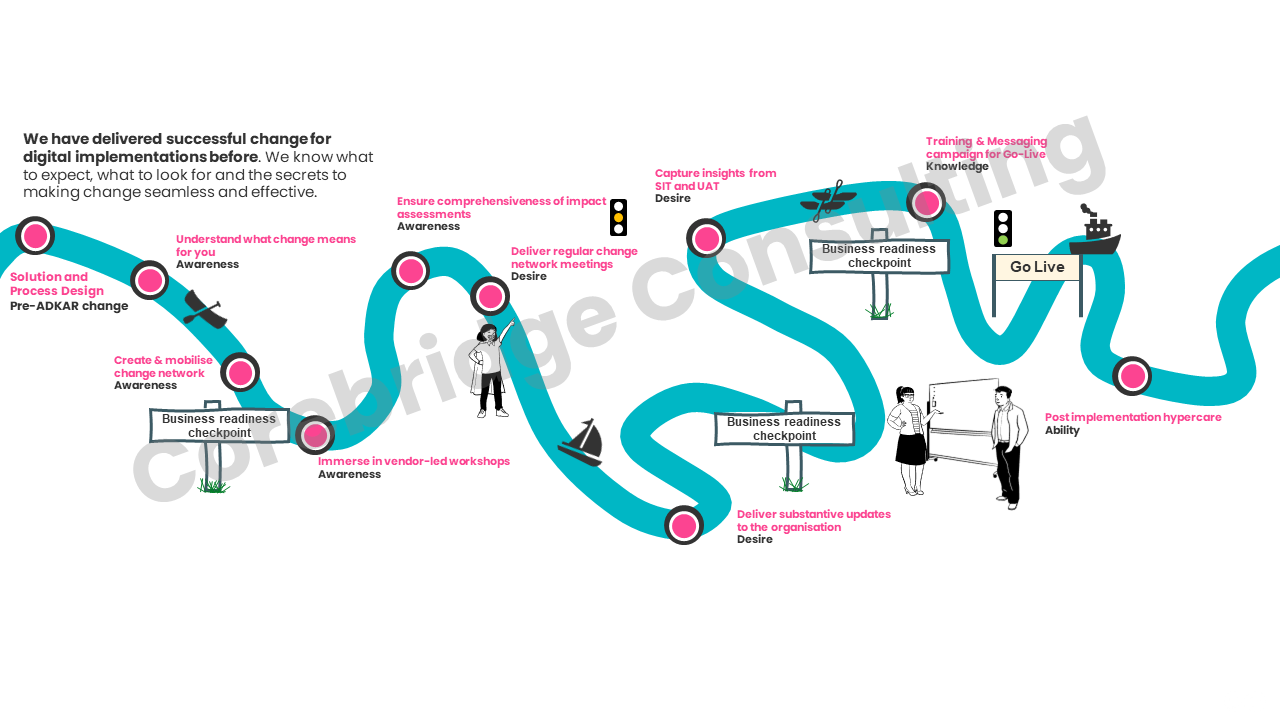
We believe in a tailored approach to digital transformation. We partner with clients and technology providers to ensure a seamless integration of digital solutions that are customised to meet unique business needs. While we are well-versed in best practice frameworks, such as Agile, Lean, Six Sigma and ADKAR we recognize that every engagement is unique, involving distinct people, strategies, constraints, requirements, and priorities.
Our bespoke methodology emphasizes a holistic view of digital transformation. We ensure that each component of the project is integrated and that information flows smoothly across the team. By fostering strong partnerships and maintaining open lines of communication, we help our clients navigate the challenges of digital transformation. We go beyond supporting your strategic objectives with capability and capacity; we collaborate with existing resources to ensure lasting change and embedded capability. This controlled and structured transition means that people know what to expect and how to handle the novel challenges of go-live and the embedding of enhanced business as usual functions. Additionally, we focus on continuous improvement and help clients realise the full value of the powerful new tools at their disposal.
Asking the right questions at the right time is essential for the success of any digital transformation initiative. Here are some critical questions to consider:
1. Do you have a clear strategy and articulation of digital transformation benefits?
Digital transformation can be costly and time-consuming, does your strategy support the change, and do you have a clear understanding of the benefits of transformation?
2. Does your planned digital transformation go far enough?
Many benefits of transformation, particularly those related to process efficiency and automation, are enhanced when entire functions, processes or parts of the value chain are digitised. However, many organizations fall into the trap of satisficing—settling for minimal or partial digital transformation efforts. This approach risks introducing unnecessary complexity, both for business-as-usual operations and for future upgrades and integration. To avoid this, it's crucial to plan for comprehensive transformation that fully leverages digital capabilities across the organization.
3. How must your operating model change to maximise the benefits of your transformation?
Digital transformation can cause a step change in process efficiency, resource utilisation and capability requirements and data availability. Have you considered how your current operating model will need to change during and after your digital transformation?
4. Have you fundamentally integrated change management into your digital transformation roadmap?
Digital transformation is not linear, it requires iterative review, feedback and design to meet the needs of your organisation. Effective change management is the glue between your new technology and existing business operations – it is the catalyst that drives adoption, value and longevity.
5. How will new user roles and security permissions integrate with the organisation’s existing architecture?
User roles connect your people to the technology being implemented. The temptation to use out-of-the-box user roles can cause friction during implementation as users are often provided with either too many, irrelevant capabilities, or not enough capabilities to leverage the functionality and value of the digital investment. User role mapping and security permissions should be business-led, meeting the operational needs of the organisation.
6. How will we measure the ROI of our digital initiatives?
Consider how you can measure the benefits and ROI of your digital transformation to track value, encourage desired business activity and reduce the risk of process workarounds or relapse.
Corebridge offers comprehensive capabilities in digital transformation, backed by a team of industry leaders with deep experience driving business success through innovative technology solutions. We provide end-to-end services, including strategic planning, technology selection, implementation, integration, and ongoing support.
Partner with us to embark on your digital transformation journey and unlock the full potential of your business through contemporary technology and innovative solutions.
Every organisation is inherently a data organisation. Regardless of the industry or size, businesses generate, collect, and rely on data to make informed decisions, optimise operations, and drive innovation. An organisation’s data maturity reflects how effective an organisation is at achieving this.
Measuring an organisation's data maturity is crucial for several reasons. Firstly, it provides a clear assessment of the current state of data capabilities, identifying strengths and areas for improvement. This understanding enables organisations to strategically allocate resources and prioritise initiatives that enhance data management and utilisation. By benchmarking against industry standards or leading practices, organisations can set realistic and achievable goals, fostering a culture of continuous improvement.
An enterprise approach to data maturity helps in aligning data-driven strategic planning with overall business objectives. It ensures that data initiatives are not conducted in isolation but are integrated into the broader strategic framework, enhancing decision-making, operational efficiency, and innovation. Mature data practices lead to improved foundational aspects of data management, enabling more effective use of advanced analytics and artificial intelligence. This ensures your organisation remains competitive and meets customer’s demands.
Assessing your data maturity through a lens that goes beyond technology, helps build foundational capabilities that are essential for sustained growth. Doing so, ensures that data practices are scalable and adaptable, allowing organisations to seamlessly incorporate new technologies and methodologies as they evolve. By establishing these strong foundations, organisations are better equipped to leverage data as a strategic asset, driving sustained growth, and enabling more sophisticated data applications and innovations in the future.
Tried and tested models offer a reliable foundation for defining an organisation's analytics maturity. These models conduct maturity assessments across key data domains, most of which are similar in approach and application.
Established models provide a solid baseline for assessing analytics maturity, yet they often fall short due to inherent challenges, such as:
These challenges highlight the importance of adapting and evolving data maturity models to better address the dynamic nature of data practices and the critical role of people and culture in achieving data maturity.
We propose a model that incorporates the fundamental domains of leading practice with the flexibility to tailor sub-domains in accordance with industry focus, technology innovations and organisational strategic ambitions.
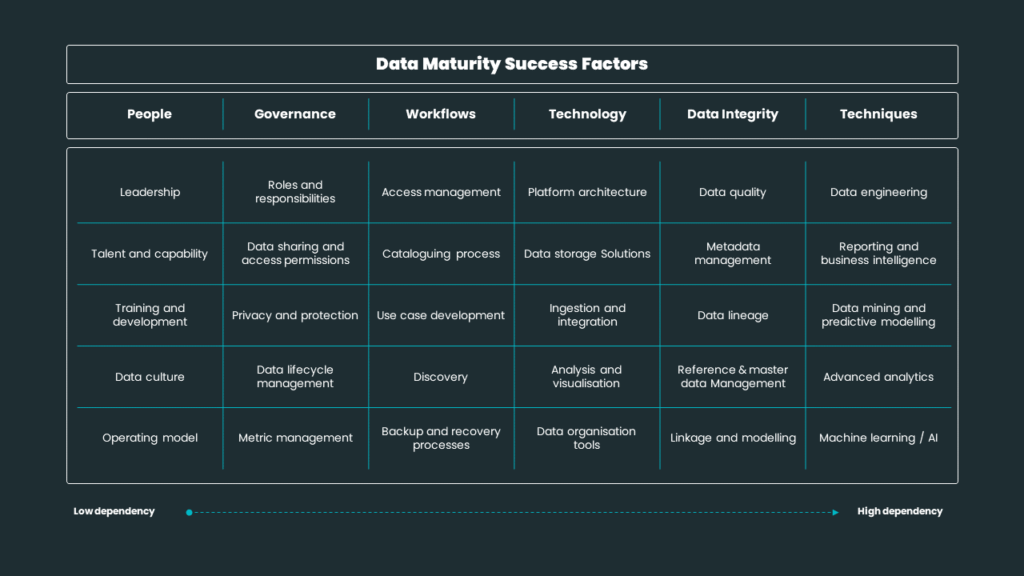
Our model provides a framework for assessing the critical aspects of data maturity across six primary domains:
The structure of the model seeks to account for the natural dependency between ‘Techniques’ and ‘People’ domains, helping to shape and prioritise future state design. For example, a high degree of maturity in ‘machine learning / AI’ requires organisations to have substantial maturity across most aspects of the model. Conversely, embedding strong data leadership has minimal interdependent sub-domains and may be prioritised for uplift.
Fundamentally, the domains of the model remain categorical and unchanged. This allows for the sub-domains to grow and reorder as the technology advances, ensuring that the model can scale flexibly. Our Data and Analytics Practice has applied this model across a variety of organisations and industries. For more information on how it may be applied in your organisation please contact our head of Data and Analytics.
A business case seeks to provide the rationale and evidence supporting a proposed investment. Current fiscal pressures and increased scrutiny over company resource allocations is driving the increased demand for high quality business cases.
A well-written business case outlines the objectives, evaluation of alternatives, benefits, costs, risks, and demonstrates how it helps achieve the strategic goals of the organisation. It’s a critical tool in assisting organisational decisions to assess the feasibility, rationale and potential value in progressing with a potential investment.
Poorly structured business case may lack sufficient detail, use unrealistic assumptions, or omit important information. These flaws can lead to incorrect decisions, wasted resources, missed opportunities, or failed projects.
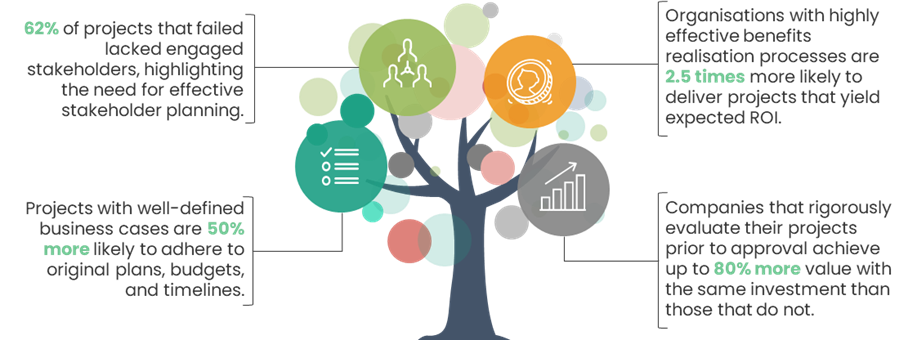
A well-developed business case seeks to be clear, comprehensive, and compelling to increase the likelihood of successful outcomes. It should include the following components:
Business cases are essential documents that explain the rationale and evidence for a proposed investment or change. Understanding the why behind every investment assists organisations understanding which investments will deliver on their strategic objectives.
Strategy execution remains one of the most challenging aspects of delivery. To close the gap between planning and action, organisations need to change current practice and enhance ways of working. Achieving this, can be a demanding undertaken and often requires a diverse application of tools and techniques that are outside their business-as-usual activity.
Unless your strategy is “keep doing everything the same”, your organisation will likely require a transformation program to deliver on its desired future state.
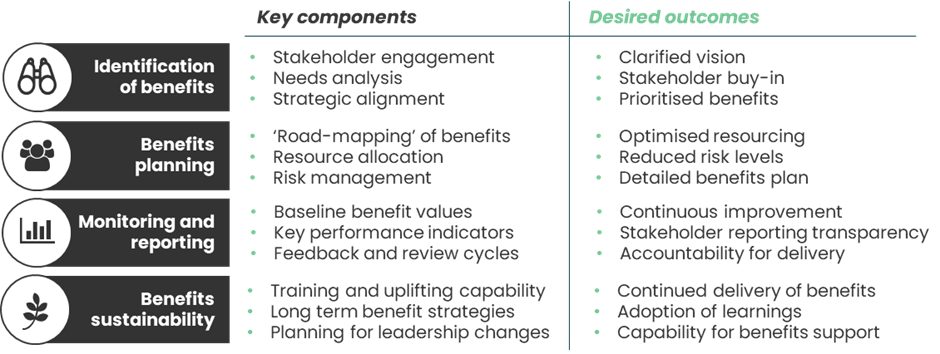
The initiatives designed to deliver the objectives of your strategy will likely require a significant level of investment. Understanding how the defined scope will make a measurable progress on the strategy is the role of benefits management, which demonstrate the expected and actual value of any future state investments. Borrowing a term from a famous author – the use of benefits provides a framework to ‘begin with the end in mind’. When done well, benefits management can justify the investment required and to monitor its performance and impact.
The following principles provide visibility on how your organisation is delivering on its strategy and realising benefits.
Align benefits with strategy. Benefits need to demonstrate the progressive achievement of strategic objectives. This may require consideration of multiple levels of benefits over multiple time horizons, to understand the big picture of organisational capabilities and how change to current practice will deliver the required results. Having a clear vision of your organisation’s success, facilitates the ability to plan for its realisation.
Identify measure of success with unambiguous language. What does our end goal mean in clear measurable terms? Are we seeking to increase customer retention or are we looking to grow into a new market segment? The benefits and associated measures need be identified at the outset with the end states in mind. This requires utilising consistent language with clear metrics to ensure alignment with the ability to measure. Understanding what you are planning to measure will also assist with understanding where to source reliable data.
Stakeholder perspectives need to be integrated into program design and delivery. The people within your organisation are the primary mechanism through which change will be delivered. Well-structured and planned stakeholder engagement can help to avoid the common pitfalls of program failure, such as scope creep, cost overruns, quality issues, and stakeholder dissatisfaction. Engagement with leadership and on-the ground staff for benefits will ensure:
Set realistic timelines. Realistic timelines should be established to account for implementation of the full scope of change required to achieve the objectives. It is only once this change has been completed that benefits can commence realisation. Most benefits will be progressive and not be realised immediately. To account for this, achievable targets need to be set, with consideration for overall organisation capacity and capability to handle the expected change.
Write it down in a benefits plan. The plan should outline the activities, resources, responsibilities, calculation methodologies and timelines for delivering the benefits. This needs to include where the data will be sourced from and how it will be reported. Measuring baselines will assist in knowing where the organisation is currently. The plan needs to be a clear roadmap of the scope required to bridge the gap between the current baseline performance and the desired future state as per the strategy.
Governance and reporting at the senior levels. Senior leadership needs to review and evaluate benefits and progress to realisation through formalised governance. This governance ensures that visibility of the overall end state is maintained, with any roadblocks to realisation addressed. Benefits measures should be compared with forecasts with clear actions and ownership for interventions to ensure achievement of the objectives.
The following table summarises the key components of benefits management and outcomes they provide.